Virtue and vice
Le Morte d'ArthurVirtue and vice are presented in Morte Darthur as competing forces within a flawed chivalric world, not as a simple division between good and bad characters. The book’s moral force lies in this tension: violence can defend kingdoms against cruel oppression, while conduct admired as prowess may also shade into injustice; wrongdoing is sometimes treated with insufficient severity, yet its consequences and the contrast with exemplary knights invite judgment. Caxton’s preface makes that mixed record an explicit lesson: readers are to remember and follow the good, and leave the evil.
Moral setting and the book’s mixed record
The prefatory critic places Malory’s moral world in the social disruptions of Edward IV’s reign: the suppression of the Lollards, the Wars of the Roses, and the court’s licentiousness. Against that background, Morte Darthur remains a portrait of a society morally lower than the critic’s own, and one whose narrator and characters often show less repugnance toward its evils than a good person would feel. Its violence and sexual wrongdoing cannot simply be excused as harmless features of an ideal age.
Yet the critic also resists treating the whole work as an endorsement of vice. Malory generally attempts, however imperfectly and confusedly, to distinguish virtue from wrongdoing and to condemn the latter. Even where the moral standard differs sharply from a modern one, the narrative can register that difference rather than conceal it. The result is an uneven but discernible effort to support the nobler elements of the society it depicts and to move them toward further moral gains.
Violence, justice, and knightly conduct
The book’s many acts of violence have more than one moral meaning. In the prefatory account, much of the apparent “open manslaughter” is committed in suppressing cruel oppressors and restoring kingdoms from anarchy to lawful government. Such conflicts call forth not only courage and hardiness but also gentleness, forbearance, and self-sacrifice. Force is therefore judged partly by its purpose and by the conduct surrounding it, rather than treated as virtuous merely because a knight prevails.
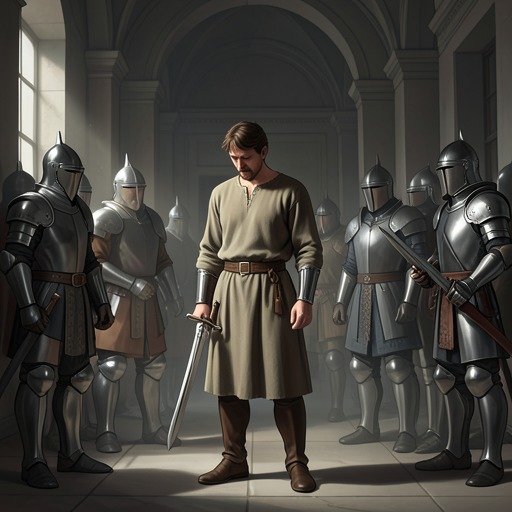
That distinction is given institutional form when Arthur establishes the Round Table’s code after the quests associated with the white hart, the brachet, and the lady carried off by a knight. The knights swear to commit no outrage or murder, flee treason, refrain from cruelty, and show mercy to anyone who asks for it; denying mercy risks the forfeiture of Arthur’s worship and lordship. They must also succour ladies and gentlewomen on pain of death and refuse battles fought in a wrongful quarrel, whether for law or worldly goods. The oath is renewed each year at Pentecost. The code sets clear ideals, but its need for repeated renewal also places those ideals in a world where they are continually at risk.
Arthur’s treatment of Sir Damas and Sir Ontzlake offers a concrete contrast between status and merit. Although Arthur has fought as Damas’s champion, he judges Damas to be proud, villainous, and unworthy in his deeds. He orders Damas to yield his manor to his brother, retain only the right to a yearly palfrey, cease distressing knights-errant, and release the twenty knights he has held prisoner. Ontzlake, by contrast, is recognized as a good, valorous, true, and gentle knight and invited to Arthur’s court. Arthur’s judgment links honor to conduct and makes the release of prisoners part of the remedy for Damas’s abuses.
Love, guilt, and consequence
The prefatory critic acknowledges the force of Roger Ascham’s charge that the book’s pleasures include killing without just cause and adultery pursued through cunning, but argues that Ascham overstates the evil by overlooking the good. The critic finds an implicit judgment of lawless love in its tragic ending: actions may be indulged or softened in the telling, but their consequences prevent the reader from treating them as morally innocent. Virtue and vice are thus not represented only through explicit rules; the outcomes of a story can supply a judgment that its characters do not always articulate.
The account of Tristram illustrates both the weakness and the movement of that moral treatment. The critic calls the hero’s conduct extremely ungrateful and profligate, while observing that a later romance’s effort to palliate it by making King Mark especially worthless was thought necessary in a way the earlier romance had not required. For the critic, that change signals moral progress: the story’s treatment of wrongdoing has become harder to sustain without qualification. The example does not erase the conduct’s wrongfulness; it reveals how narrative sympathy and the standards used to judge a hero can themselves change.
Launcelot presents a more direct struggle between wrongdoing and moral recognition. The critic describes him as making sincere but weak efforts against temptation, then becoming penitent when the punishment of his guilt brings sorrow to those dear to him as well as to himself. His arc makes remorse and consequence part of the book’s moral argument: affection and prowess do not cancel culpability, though recognition of harm can lead to penitence.
The exemplary knights and Caxton’s instruction
Sir Galahad and Sir Percivale, identified as maiden knights, offer a contrasting ideal. Their lives provide a standard of spiritual purity against which the book’s other forms of love and conduct can be measured. The prefatory critic does not treat their celibacy as the universal moral ideal: the text’s deepest failure, in this critic’s judgment, is that it does not clearly establish marriage as the highest and purest realization of human relations. Still, the maiden knights supply an unmistakable counter-image to a world in which desire and misconduct can be treated too indulgently.
Caxton’s preface gathers these contrasts into an explicit programme for reading. It names courtesy, humanity, friendliness, hardiness, love, and friendship alongside cowardice, murder, hatred, virtue, and sin, asking readers to retain the honest acts and follow them. The preface allows readers freedom to decide whether every history is true, but presents the book as instruction: its stories warn against vice and sin and encourage the exercise of virtue. On this account, the work’s mixed moral contents are not a reason to imitate everything its knights do; the distinction between the good to follow and the evil to leave is the lesson.
Critical perspective and moral progress
The prefatory assessment places Malory between earlier and later standards of moral expression. Comparing Malory with Chaucer, it sees brutish vice diminished and more clearly recognized as vice, while virtue appears more openly triumphant, even if it is not inherently more elevated. This is a qualified claim of progress, not a declaration that Malory has reached the moral standard of a later age. The critic further argues that the book may itself have helped advance that change, supporting Caxton’s belief that printing it served his countrymen.
The result is a moral design marked by contradiction: knightly violence can restore order, but the same culture can tolerate wrongful conduct; a hero may receive sympathy, but guilt can end in penitence and grief; exemplary purity is visible, yet the ideal of marriage remains unclear. Virtue and vice matter because the book does not resolve these tensions by presenting a flawless society. Caxton’s instruction instead asks readers to discriminate within its stories, taking their humane and courageous deeds as models without mistaking wrongdoing for honor.